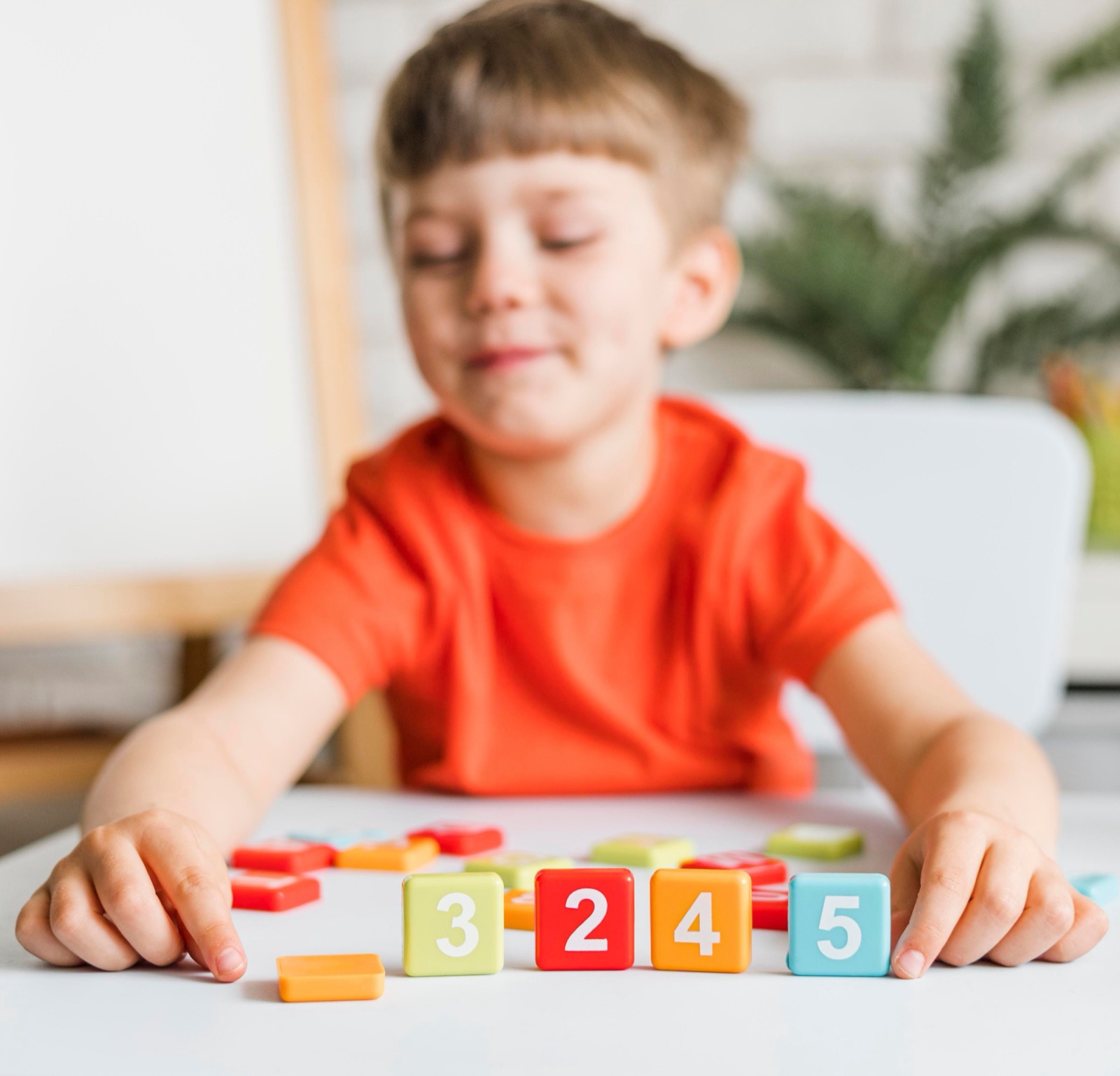
By the end of kindergarten, most children in a US classroom can count to 100 by ones and by tens, count out up to 20 objects without skipping or double-counting, write the numbers 0 to 20, say which of two numbers up to 10 is bigger, add and subtract within 5 without counting, and find the pairs that make 10 using fingers, counters or a drawing. And in June it is completely normal for the same child to stumble on the teen numbers, count on their fingers, write a 3 or a 7 backwards, need objects for anything bigger than 5, and know something on Monday that has vanished by Tuesday.
Both lists are true at once, which is why one worksheet can't tell you whether your child is behind. Here's the end-of-year picture, what's normally still under construction, and when to talk to the teacher.
What are kindergartners expected to know by the end of the year?
The list below is drawn from the Common Core kindergarten standards, which most states use in some form; your state's version may differ in details, and curricula teach these in different orders. In plain language, by June a kindergartner is expected to be able to do the things in the middle column.
| Area | By June, most kindergartners can… | Try it at home |
|---|---|---|
| Counting | Count to 100 by ones and by tens; count forward from any number instead of starting at 1; count up to 20 objects in a row (or 10 scattered), knowing the last number said is the total; count out a given number of objects; write the numbers 0–20 | "Start at 6 and keep going." "Give me 13 blocks." "How many grapes?" Then move them and ask again. |
| Comparing | Say whether one group has more, fewer or the same as another, up to 10; compare two written numbers up to 10 | Two handfuls of cereal: "Which has more? How do you know?" Two number cards: "Which is bigger?" |
| Adding and subtracting | Add and subtract within 10 with objects, fingers or drawings, including simple word problems; break numbers up to 10 into pairs (5 is 2 and 3, or 4 and 1); for any number from 1 to 9, find what makes 10; add and subtract within 5 from memory | "You have 4 crackers and I give you 2. How many?" "Show me two ways to make 6." "What goes with 7 to make 10?" |
| Teen numbers | See 11 to 19 as ten and some more (18 is 10 and 8) | A full ten-frame plus extras: "Ten and three is…" |
| Measuring and sorting | Describe length and weight; compare two objects (taller, heavier); sort objects into groups and count each group | "Which spoon is longer?" Sort the laundry by owner and count the piles. |
| Shapes | Name squares, circles, triangles, rectangles, hexagons, cubes, cones, cylinders and spheres in any orientation; tell flat from solid; use above, below, beside, in front of; build shapes and combine them | A shape hunt in the kitchen. "Can you make a rectangle out of two squares?" |
Notice how often the standards say "with objects or drawings." Only one line asks for anything from memory, and that's adding and subtracting within 5. Everything else is allowed to be slow, physical and visible at the end of kindergarten.
What's normal to still be learning in June?
The teen numbers. If your kindergartner counts "ten, eleven, twelve, fourteen, sixteen" or reads 13 as thirty-one, you're looking at the single most common sticking point of the year. The reason is English, not your child. "Eleven" and "twelve" are new words with no pattern, and the rest of the teens are only roughly patterned; the federal Institute of Education Sciences' training material for teaching young children math says plainly that the numbers up to 20 essentially have to be memorized, and that matching the memorized string to real objects is harder again. Practice the teens on a ten-frame: fill ten, add three, say "ten and three, thirteen." The standard only asks that kindergartners begin to see teens as ten-and-some-more.
Writing numbers backwards. A mirrored 3, 7, 5 or 6 in kindergarten is a sign of being five, not a sign of a learning difference. Understood, the learning-differences nonprofit, puts the typical end of reversals around the end of second grade and notes that reversing letters or numbers isn't by itself a sign of dyslexia. Reversals that are still frequent after age 7, alongside reading or language trouble, are worth raising with the teacher.
Counting on fingers and needing objects. Expected. The standards ask for adding "with objects, fingers, drawings," and children who count on their fingers in kindergarten are more accurate, not less. Fingers become something to work on in second grade, not now; here's the age-by-age answer on finger counting.
"What comes after 7?" A child who can add 3 + 2 with blocks but freezes when asked what comes after 7 isn't being contradictory. Counting from 1 is a memorized chant; starting in the middle of the sequence is a separate skill, and the standards list it separately for that reason. Practice it in the car: "Start at 7." "Start at 14."
Subtraction. It trails addition by months for almost everyone. "Take away" problems with real crackers are the whole curriculum here; worksheets can wait.
Guessing. A child who blurts "six!" before looking is usually telling you one of two things: they don't yet trust that counting gives a reliable answer, or they've learned that a fast answer makes grown-ups happy. Slow it down. "Show me with the blocks" turns a guess into a count, and the idea that matters most in kindergarten, that the last number you say is how many there are, is built exactly there.
Good days and bad days. A skill that's there on Monday and gone on Tuesday is a skill being learned, not lost. A kindergarten assessment catches one day. Your kitchen table catches forty.
Is my kindergartner behind?
Early number sense matters a great deal: in one study, kindergarten number sense and how fast it grew accounted for about two-thirds of the differences in children's first-grade math achievement. So "they'll grow out of it" is not a plan. But a single kindergarten screening is weak evidence about any one child. In the same research group's follow-up, a well-designed kindergarten screen flagged roughly one in six children who went on to have no trouble at all with arithmetic in second grade, and missed about half of the children who did. One test on one morning is a reason to look closer, in both directions, not a verdict.
Age matters too, and the standards don't adjust for it. A child who turned five in August sits next to a child who turned six in September. A year's difference at this age is enormous, and "below expected" in May for the younger child often means "on track for their age."
What's worth a conversation with the teacher in the spring of kindergarten, not because any of it is a diagnosis but because each is a standard the year is built on:
- Can't count to 20 reliably, or counts 10 objects by skipping or double-counting most of the time.
- Doesn't yet know that the last number counted tells how many (counts "one, two, three, four, five," then, asked how many, counts again or guesses).
- Can't say which of 3 and 7 is more, with the objects in front of them.
- Doesn't recognize the written numbers 1 to 10.
- Avoids counting entirely, or melts down at any math at all. That's a different problem; here's what to say when a child cries over math.
Ask the teacher what they see in class, where the child isn't performing for a parent. If they share your concern, ask what the school's next step is; the first response the research supports is more frequent, more targeted practice, not a label.
What can I do at home in ten minutes a day?
Count everything, out loud, with you: stairs, grapes, socks. Ask "how many?" afterwards, and sometimes move the pile and ask again, so the child learns the answer doesn't change. Ask "what comes after?" from random starting points. Play "show me" with fingers, fast: "Show me 7." Make ten on a ten-frame drawn on paper with ten pieces of cereal: "There are 6. How many more to fill it?" Roll two dice: which is bigger, and how many altogether? Hunt for shapes.
Keep it to a few minutes and keep score of nothing. A University of Chicago study of 587 first graders found that families doing short bedtime math story problems on a tablet, even as little as once a week, had children with higher math gains by the end of the year, and the biggest gains went to children whose parents were most anxious about math.
If you'd like some of that practice to run without you reading every question, Mathwell is built for this age. Mathwell is a browser-based K–5 math tutor that reads every problem aloud and teaches with hints instead of answers, so a kindergartner who can't yet read "which number is bigger?" can hear it and work on their own, and a child who's stuck gets a smaller step from the Tutor rather than the answer. Anyone can try the demo lesson without signing up; after that there's a 7-day free trial with a card on file, then $19 a month, $99 a year, or $169 for a three-year K–5 pass. It covers kindergarten through fifth grade only, and the child answers by tapping or typing, not by speaking. For a child who'd rather hold a pencil, the printable puzzle sheets for grades 1–2 suit a kindergartner at the end of the year.
FAQ
My 5-year-old can't recognize numbers past 10. Is that normal?
In the fall and winter, yes; the teens are the hardest numbers to learn in English. By the end of the year most kindergartners read numerals to 20. If 11 to 19 are still shaky in June, practice them on a ten-frame over the summer and mention it to the first-grade teacher.
My kindergartner guesses instead of counting. Should I worry?
Not yet. Replace "what's the answer?" with "show me," and give the child time. If, by spring, counting 10 objects still ends in a guess rather than a count, ask the teacher what they see.
Is it normal for a 5-year-old to write numbers backwards?
Yes. Reversals are common through second grade and aren't by themselves a sign of dyslexia. Reversals that are still frequent after age 7, especially with reading trouble, are worth raising.
What comes next in first grade?
Adding and subtracting within 20, fluency within 10, and the strategies that replace counting: counting on, making ten, and using doubles.
Sources
-
Common Core State Standards for Mathematics, Kindergarten: Counting & Cardinality · Operations & Algebraic Thinking · Number & Operations in Base Ten · Measurement & Data · Geometry · Grade 1, Operations & Algebraic Thinking. Text mirrored at thecorestandards.org.
-
Institute of Education Sciences, What Works Clearinghouse: Teaching Math to Young Children practice guide (2013) · companion training module, example responses on counting and the teen numbers (PDF)
-
Jordan et al. (2006), Learning Disabilities Research & Practice, and Locuniak & Jordan (2008), Journal of Learning Disabilities: kindergarten number sense, later achievement and screening accuracy. Summaries on the authors' lab page, University of Delaware
-
Understood, FAQs about reversing letters, writing letters backwards, and dyslexia
-
Berkowitz et al. (2015), Math at home adds up to achievement in school, Science. University of Chicago summary
-
Parent threads: r/kindergarten, Nov 2024 · kindergartner falling behind · stuck on the teen numbers (The Well-Trained Mind forums)