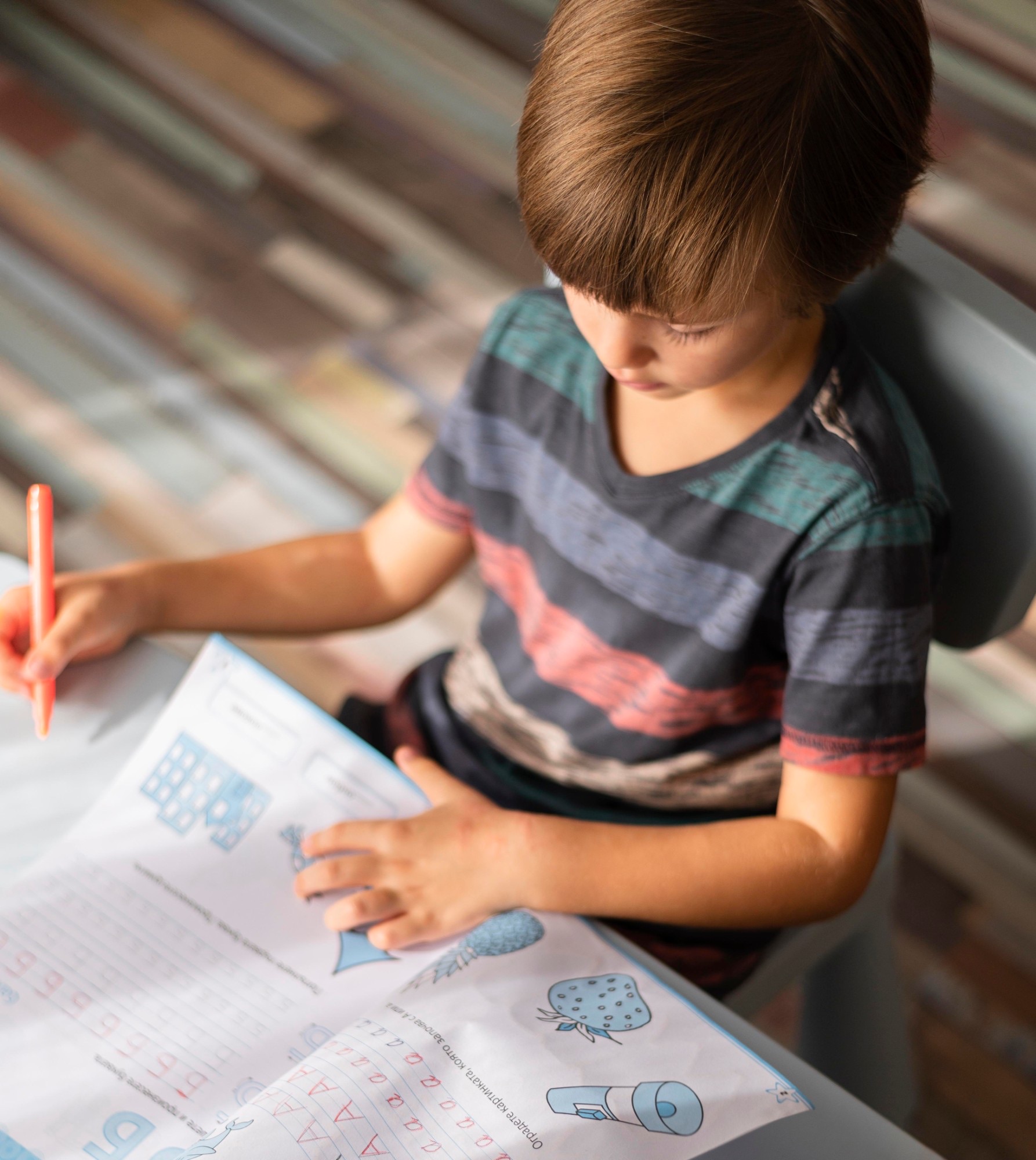
A kindergartner who counts "nine, ten, eleven, twelve, fourteen, sixteen" or reads 14 as forty-one is not behind. They've hit the hardest stretch of numbers in the English language, and almost every child stalls there. The words from eleven to nineteen hide the one thing that would make them easy: that each is a ten and some more. "Eleven" and "twelve" say nothing about ten at all; "thirteen" says "three-ten" backwards; and the written numbers put the one on the left while the word puts it last. Children learning in Chinese, where 11 is literally "ten-one," don't get stuck here. The fix is to teach the teens the Chinese way, with a full ten-frame and the words "ten and three," for five minutes a day until "thirteen" means something.
Why are the teen numbers so hard?
Three reasons, and all of them are about English, not your child.
The words don't follow the pattern. Up to ten, every number has its own name and children memorize them as a chant. From twenty on, the names are regular: twenty-one, twenty-two, thirty-one. The teens are neither. The federal Institute of Education Sciences' training material for teaching young children math puts it plainly: "eleven" and "twelve" are completely new words for children, the rest are only roughly patterned ("thirteen" is somewhat like "three-teen" but still odd), and the numbers up to twenty essentially have to be memorized. A child who muddles thirteen and fifteen is doing what you'd expect with two long words that sound alike and tell you nothing.
The words run backwards. "Fourteen" says four first, then ten. The numeral 14 shows the one first, then the four. A five-year-old who writes 41 for fourteen is writing the word in the order they hear it, which is the sensible thing to do. (The same mismatch makes fourteen and forty hard to tell apart by ear, and it never fully goes away; adults mishear them too.)
The pattern is hidden exactly when children need it. The point of the teens is that 13 is ten and three. In Chinese, Japanese and Korean the number words say so: eleven is "ten-one," twelve is "ten-two." In a well-known 1995 study, American and Chinese four- and five-year-olds counted equally well up to about 12, and then the Chinese children pulled about a year ahead on the higher numbers, which the researchers attributed to the number names. Later work has found the advantage is specific rather than sweeping: transparent number words help with counting and with place value, not with arithmetic in general, and other factors matter too. But on the narrow question of why your child is stuck at eleven, the answer is the words.
What are kindergartners expected to do with teen numbers?
The kindergarten standards most states use ask children to count to 100 by ones and tens, to count forward from any number instead of starting at one, to write numbers to 20, and, in one standard that is the whole point of this post, to "compose and decompose numbers from 11 to 19 into ten ones and some further ones," recording it as a drawing or an equation such as 18 = 10 + 8. That's the kindergarten version of place value, and it's the foundation for everything with two digits later: 23 is two tens and three, 47 + 30 is "four tens plus three tens," and regrouping in second grade is nothing but moving a ten across.
So the goal isn't that your child can recite the teens. It's that "fourteen" calls up a picture of a full ten and four more. Children who have that picture don't read 14 as 41, don't muddle 13 with 15, and don't stall at 11; the pattern carries them.
Is my child behind if they can't count past 11?
In the fall of kindergarten, no. Most five-year-olds stall somewhere in the teens, and the standards give the whole year to sort it out. By the end of kindergarten, most children can count to 20 and beyond and read the teen numerals; a child who is still shaky on 11 to 19 in June should spend the summer on the routine below and have it mentioned to the first-grade teacher. What a kindergartner should know by June has the rest of the end-of-year picture.
Two things that look like trouble but aren't: a child who counts to 29 and then says "twenty-ten," which is a child who has found the pattern and is applying it, correctly, to a language that broke it; and a child who writes 3 or 7 backwards, which is ordinary through second grade.
How do I teach the teen numbers at home?
Teach them as "ten and some more," with something to look at, for five minutes a day. Here's the routine; a week or two on each step is normal.
1. Make the ten real. Use a ten-frame: a two-by-five grid drawn on paper, or an egg carton with two cups cut off. Fill it with ten pieces of cereal and call it "a full ten." Let the child fill it, empty it, and say "ten" without counting the pieces. A full frame should be recognizable at a glance, the way a hand is five.
2. Say the teens the Chinese way first. Put the full ten down, then three more beside it. "Ten and three. We call that thirteen." Then ten and four, "fourteen." Then ten and one, "eleven," which is the one to repeat most, because the word gives nothing away. Always the picture, then the long name, then the real name. After a while, drop the long name.
3. Go from the number to the picture. Say "sixteen" and have the child build it: full ten, six more. Say "eleven." Then show a numeral, 17, and have them build that. This direction, from the word or numeral to the quantity, is where thirteen and fifteen stop being interchangeable.
4. Write it as ten plus. "Fourteen is ten and four. 14 = 10 + 4." Point out that the 1 in 14 is the full ten and the 4 is the extras. This is the moment 41 stops being a plausible spelling of fourteen: the ten comes first in the picture, so it comes first on paper.
5. Count across the teens with the picture in view. With the frame full and a pile of extras, count up from ten: "ten, eleven, twelve..." adding one piece each time, so the child sees the extras grow. Then count down. Counting backwards through the teens is hard for English speakers specifically, and a minute of it a day is worth more than it looks.
Here's what step 3 sounds like with a five-year-old who confuses thirteen and fifteen:
- Parent"Show me fifteen."
- Child (fills the ten, adds three)"There."
- Parent"Ten and how many more?"
- Child"Three."
- Parent"Ten and three is..."
- Child"Thir-teen. Oh. Fifteen is ten and five." (Adds two.)
- Parent"Say the whole thing."
- Child"Ten and five, fifteen."
No correcting, no "wrong." The frame did the correction.
If you'd like the ten-frames to show up without you drawing them every night, that's how Mathwell teaches the teens and the addition that follows: a full ten on screen with the extras beside it, the Tutor reading each problem aloud, and a hint that points at the frame ("how many more than ten?") when the child is stuck, rather than the answer. Mathwell is a browser-based K–5 math tutor that reads every problem aloud and teaches with hints instead of answers; anyone can try the demo lesson without signing up, and after that there's a 7-day free trial with a card on file, then $19 a month, $99 a year, or $169 for a three-year K–5 pass. It's for kindergarten through fifth grade only, and the child answers by tapping or typing, not by speaking. The egg carton works fine too.
What comes after the teens?
Everything, which is why this is worth a month of five-minute sessions. A child who sees 14 as a ten and four will see 24 as two tens and four with almost no new teaching, and will find "make a ten" in first grade (8 + 5 is 10 and 3) an obvious move instead of a mysterious rule. The ten-frame doesn't retire after kindergarten; it's the same picture that carries addition within 20, and the age-by-age answer on finger counting shows how.
FAQ
My 5-year-old can't count past 11. Is that normal?
In kindergarten, yes; the teens are the hardest numbers in English and most children stall there for a while. Use the ten-frame routine above for a few weeks. If a child is still stuck at 11 at the end of kindergarten, mention it to the teacher.
My child reads 14 as 41. Should I worry?
No. The word says four first and the numeral shows the one first; writing 41 is a sensible mistake. It stops once the child sees 14 as "a full ten, then four" and knows the ten comes first on paper.
Why does my kindergartner mix up thirteen and fifteen?
Because the words are long, sound alike and don't say what they mean. Build both on a ten-frame (ten and three; ten and five) and have the child name the number from the picture. The confusion goes when the picture arrives.
Should I teach counting to 100 first, or the teens?
The teens, and then the pattern does most of the work for 20 to 100. A child who can count by tens and understands "ten and some more" will often get to 100 in days.
Is it okay that my child says "twenty-ten"?
It's a good sign. The child has found the pattern. Just tell them English calls it thirty, and that the pattern comes back right after.
Sources
- Institute of Education Sciences, Regional Educational Laboratory program, Teaching Math to Young Children training module 2, example responses on counting and the teen numbers. PDF
- Miller, Smith, Zhu & Zhang (1995), Preschool origins of cross-national differences in mathematical competence: the role of number-naming systems, Psychological Science. Abstract
- Mark & Dowker (2015), Linguistic influence on mathematical development is specific rather than pervasive, Frontiers in Psychology: the structure of English teen words and a re-examination of the Chinese number advantage. Full text (PDF)
- Common Core State Standards for Mathematics, Kindergarten: Counting & Cardinality · Number & Operations in Base Ten, K.NBT.A.1. Text mirrored at thecorestandards.org.
- Parent threads: "stand still with teen numbers" · six-year-old muddling 13, 14, 15 (The Well-Trained Mind forums)