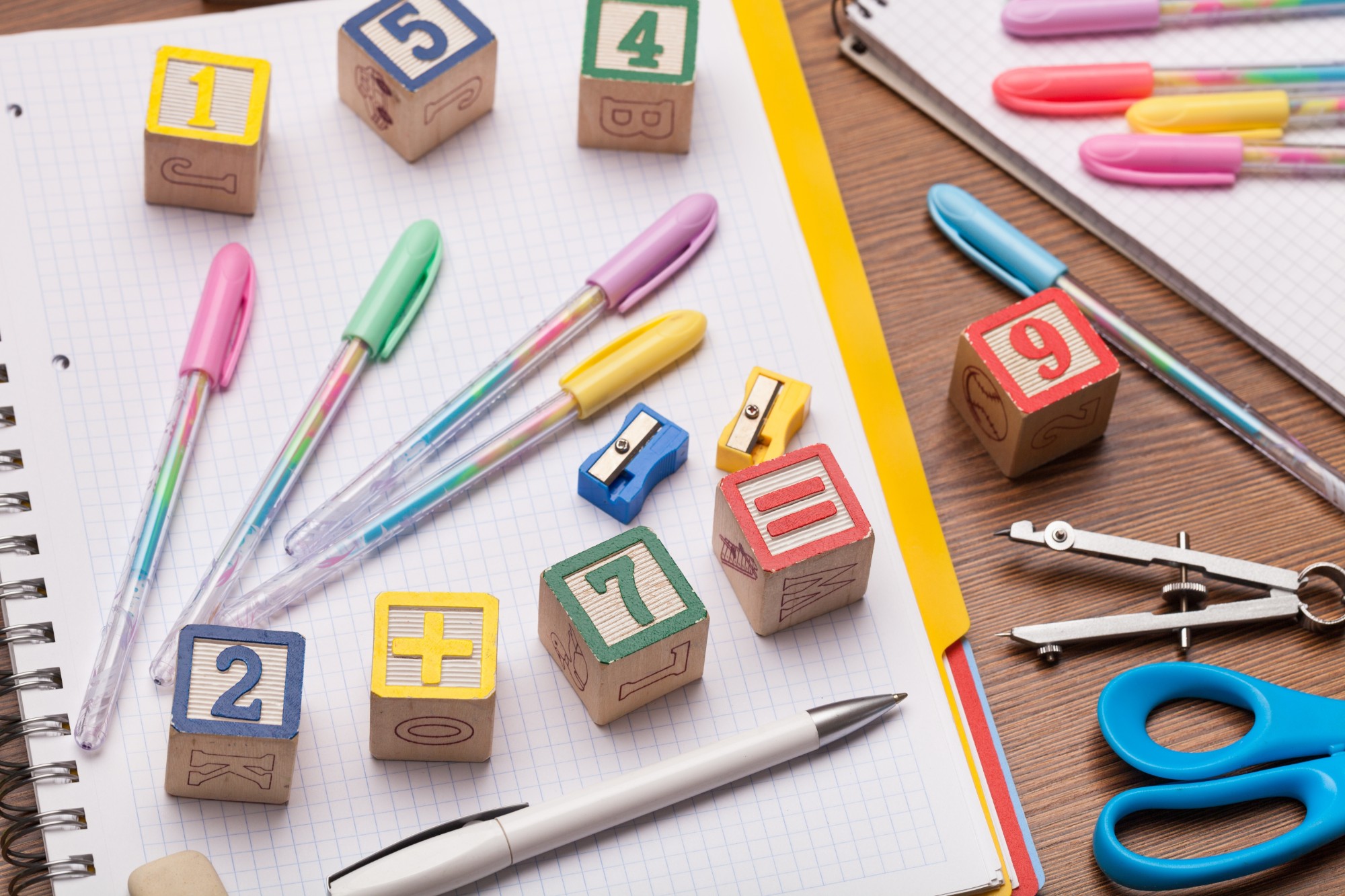
A deck of cards and two dice cover most of what a kindergartner through third grader needs to practice: counting, comparing, making ten, adding and subtracting within 20, tens and ones, missing numbers, mental math and, by third grade, the times tables. The ten games below take five minutes each, need no printing, and have one rule in common: the child says the math out loud. Games are listed youngest to oldest, each with a way to make it harder when it gets easy.
Take the face cards out, or keep them as 10s for the older games. Aces are 1.
Why games instead of a worksheet?
Because the research on this is unusually clear. In a randomized study with 36 preschoolers from low-income families, children who played a simple numbered board game, one-on-one with an adult, for four 15-minute sessions over two weeks (about an hour in total) improved significantly at putting numbers in order and placing numbers on a number line, compared with children who played the same game with colors instead of numbers. The What Works Clearinghouse rates the study as meeting its standards without reservations. The game was nothing special: ten squares, a spinner, and a child saying "five, six" as they moved. The saying is the point.
Two more findings shape the rules below. Short practice spread over days beats the same practice in one sitting, which is why these are five-minute games and not a game night. And a University of Chicago study of 587 first graders found that short, playful math at home, even about once a week, raised children's math achievement over the year, most of all in families where the parent disliked math. A card game is that, with the stakes removed.
The games
1. Line them up (K). Pull out the 1 to 10 of one suit, shuffle, and have the child lay them in order. Then hand over a card from the middle ("start at 6") and have them build up and down from there. Practices: number order, counting forward from any number. Harder: use two suits and build to 20, or lay the cards out with gaps and ask what's missing.
2. Flash and show (K). Flip a card (1 to 10); the child shows that many fingers as fast as they can, without counting them one by one. Then switch: you show fingers, they find the card. Practices: seeing small quantities instantly, which is the skill under all of addition. Harder: show 7 as "a hand and two" and ask for other ways to show it.
3. War (K–1). Split the deck. Each player flips a card; the bigger number takes both. Say the comparison out loud ("8 is more than 3"). Practices: comparing numbers. Harder: flip two cards each and add; the bigger sum wins (1st). Flip two and subtract the smaller from the bigger (2nd). Flip two and multiply (3rd).
4. Make-ten fish (K–1). Go Fish, but pairs are two cards that make 10 (6 and 4, 9 and 1). Ask for the card you need: "I have a 7. Do you have a 3?" Practices: the pairs that make ten, which are the foundation of every strategy for adding past ten. Harder: pairs that make 20 using two cards each, or three cards that make 15.
5. Roll and count on (1st). Roll two dice. Say the bigger number, then count on the smaller: "5... 6, 7, 8." Write the sum or just say it. Practices: counting on from the bigger number, the move that ends counting-from-one. Harder: roll three dice and find two that make ten first.
6. Biggest number (1st–2nd). Each player draws two cards and arranges them to make the biggest two-digit number (a 3 and a 7 make 73). Bigger number wins; say why ("7 tens beats 3 tens"). Practices: place value, which second-grade regrouping depends on. Harder: smallest number wins; or three cards for a three-digit number; or draw two and make the number closest to 50.
7. Race to 100 (1st–2nd). Each player keeps a running total. Roll two dice, add them, add to your total, say the new total out loud. First to pass 100 wins. Keep a hundred chart next to the board for a child who needs to see the tens. Practices: adding within 100, crossing tens. Harder: start at 100 and race down to 0 (subtraction); or roll one die and multiply by 10 before adding.
8. Salute (1st–3rd). Three players. Two each draw a card and hold it to their forehead without looking, facing the third. The third player says the sum. Each card-holder works out their own card from the sum and the card they can see. Practices: missing addends, which is subtraction in disguise and the heart of "8 + ? = 13." Harder: the third player says the product (3rd grade).
9. Close to 20 (2nd–3rd). Deal five cards. Pick three that add as close to 20 as possible; your score is the distance from 20. Lowest total after five rounds wins. Practices: mental addition, estimating, choosing. Harder: Close to 100 with two-digit numbers made from pairs of cards; or Close to 0 by adding and subtracting.
10. Pig (2nd–3rd). Roll one die as many times as you like, adding as you go; stop whenever you want and bank the turn's total. Roll a 1 and the turn's total is lost. First to 50 wins. Practices: fast mental addition and a little judgment about risk. Harder: two dice, where double 1s wipe out the whole score, and the child keeps everyone's running total.
The multiplication version of everything (3rd). War with two cards multiplied, Salute with products, and this one: roll two dice and draw the array (3 rows of 4 dots), then say the fact both ways: "3 times 4 is 12, 4 times 3 is 12." A child who has drawn the array for a fact rarely forgets the fact. The order to learn the tables in is in the times-tables routine.
Four rules that make the games teach
Say the math out loud. Not "8" but "5 and 3 is 8." Not just the answer but the route: "8 and 2 is 10, and 3 more." The research game worked because the children named the numbers as they moved; silent play teaches less.
Five minutes, most days. One game, then stop, even if they want more; especially if they want more. Coming back tomorrow is the point.
Let them win, sometimes, by playing well. Don't throw the game; do narrate your own thinking slowly enough that they can beat you by being faster. Children learn strategies by hearing yours.
Let them be the teacher. Once a game is easy, hand it over: the child deals, keeps score, catches your (deliberate) mistakes. Checking your work is harder than doing their own, and they love it.
For a child who's stuck on a strategy rather than a fact, the games aren't the fix; the finger-counting guide has the steps that come first (ten-frames, counting on, making ten), and the games then make them automatic. And if you'd rather have puzzles on paper some days, the printable puzzle sheets are thinking puzzles rather than fact practice, which is a different kind of five minutes.
What about days when nobody wants to be the dealer?
Some evenings there's no one to play against, or you'd rather not be the game master. That's what Mathwell is for: a browser-based K–5 math tutor that reads every problem aloud and teaches with hints instead of answers, so the child practices the same skills (making ten, tens and ones, facts within 20, times tables) with the Tutor doing the reading and a smaller step offered when they're stuck. Anyone can try the demo lesson without signing up; after that there's a 7-day free trial with a card on file, then $19 a month, $99 a year, or $169 for a three-year K–5 pass. It's for kindergarten through fifth grade only, and the child answers by tapping or typing, not by speaking. The card games are still the better bet for a Saturday morning, and the research above was done with a person across the table.
FAQ
What's the best math game for a kindergartner?
Line them up, then Make-ten fish. Order and the pairs that make ten are the two ideas the year is built on, and both games take a minute to explain.
My child only wants to play War. Is that enough?
For a while. Keep adding the twists (two cards, add; two cards, subtract; two cards, multiply) and War carries a child from kindergarten through third grade.
Do I need special dice or ten-sided dice?
No. Two ordinary dice cover everything here. A third die makes several games harder for free.
How often should we play?
Five minutes, four or five days a week, beats a long game on Sunday; the spacing research is clear on that. How much math a day, by grade has the rest of the schedule.
My child cries when they lose. What do I do?
Play cooperative versions for a while: both of you against the clock, or a shared running total to beat yesterday's. The math is the same; the stakes are gone.
Sources
- Siegler & Ramani (2008), Playing linear numerical board games promotes low-income children's numerical development, Developmental Science. What Works Clearinghouse review · PubMed abstract
- Berkowitz et al. (2015), Math at home adds up to achievement in school, Science. University of Chicago summary
- Institute of Education Sciences, What Works Clearinghouse (2007), Organizing Instruction and Study to Improve Student Learning, Recommendation 1: space learning over time. Guide
- Common Core State Standards for Mathematics, Grade 1, Operations & Algebraic Thinking (the strategies the games practice). 1.OA. Text mirrored at thecorestandards.org.