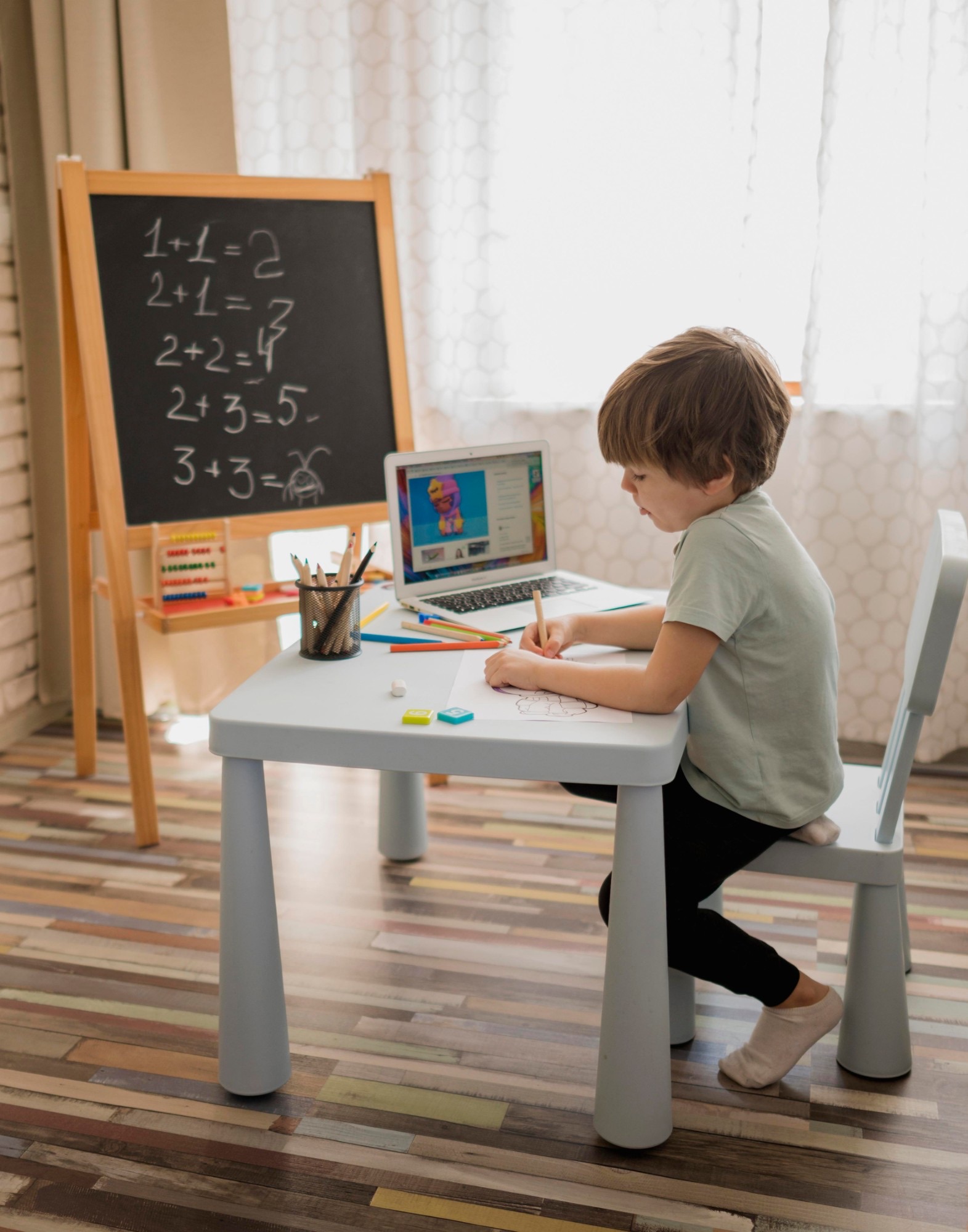
Less than most parents think, and more often. A kindergartner needs about 10 to 20 minutes of hands-on math most days. A first or second grader doing math at home, whether that's a homeschool lesson or practice on top of school, is well served by 20 to 30 minutes. By fourth and fifth grade, 30 to 45 minutes is plenty. And for a child in school, the total homework load across all subjects should stay near ten minutes per grade level, so if your second grader is at the table for an hour, the fix is a shorter session and a note to the teacher, not more effort.
The minutes matter less than the pattern. Ten minutes five days a week does more than fifty minutes on Sunday, and a session that ends while the child is still succeeding does more than one that runs until it stops working. Here's the evidence behind those numbers, then the grade-by-grade table, then what to change if math time has become a fight.
What does the research actually say about how much math time helps?
Four findings carry most of the weight.
Homework barely moves the needle in elementary school. Harris Cooper's team at Duke reviewed more than 60 studies and found that the link between homework and achievement is much stronger in middle and high school than in elementary grades, where it mostly builds habits rather than skills. Cooper's "ten-minute rule," about ten minutes a night per grade level across all subjects, is endorsed by the National Education Association and the National PTA. It starts in first grade; the guidelines don't mention kindergarten at all.
A little, often, beats a lot at once. In a study of 587 first graders, families who used a short bedtime math app together saw their children gain in math over the year, and even families who used it about once a week saw gains. Frequent users ended the year almost three months ahead of similar children who got a reading app instead.
Spacing works, cramming doesn't. In a set of experiments at the University of South Florida, students who worked the same ten math problems split across two sessions a week apart remembered far more four weeks later than students who did all ten at once; doing extra problems in a single sitting ("overlearning") added nothing. The federal What Works Clearinghouse guide on organizing instruction makes "space learning over time" its first recommendation. The home version: come back to last month's topic for a few minutes every week instead of finishing a unit and never seeing it again.
Daily math time is recommended for young children, on thin evidence. The What Works Clearinghouse guide for teaching math to young children says to dedicate time to math each day, but rates the evidence for that recommendation as minimal. Nobody has shown that 30 minutes beats 15 for a five-year-old. What's established is that early number sense predicts later math strongly, so some regular, pleasant math time matters; the exact minutes are judgment.
How long should math take, by grade?
The homeschool column below comes from where experienced homeschooling parents land in forum discussions, which is consistent across years and curricula; the school column applies the ten-minute rule and adds a few minutes of playful practice. Treat the upper ends as ceilings, not targets.
| Grade | Homeschool math lesson | Child in school: homework (all subjects) + home practice | What it looks like |
|---|---|---|---|
| Kindergarten | 10–20 min, most days | Little or no homework expected; 5–10 min of counting games | Counting real things, comparing, making ten with cereal on a ten-frame, a quick number game |
| 1st grade | 20–30 min (forum range 20–45) | About 10 min homework; plus 5–10 min of practice | A few minutes of fact practice, one new idea with objects, two or three problems |
| 2nd grade | 30 min (forum range 30–45) | About 20 min homework; plus 10 min of practice | Facts within 20, place value, a word problem or two retold out loud |
| 3rd grade | 30–45 min | About 30 min homework; plus 10 min of facts | Multiplication facts in short daily bursts, one lesson topic, a weekly look back |
| 4th–5th grade | 30–45 min, occasionally 60 | 40–50 min homework; plus 10 min of facts if they aren't automatic yet | Longer problems, fractions and decimals; split the session if attention fades |
Two notes on the table. First, a "30-minute lesson" shouldn't be 30 minutes of one thing. Five minutes of fact practice, ten or fifteen on the new idea, five on something from a few weeks ago: that structure builds the spacing in. Second, the school column adds up homework across every subject; if your third grader's math homework alone takes 30 minutes, the budget for the night is spent before reading starts.
Is an hour of math too much for a first or second grader?
Usually, yes, and parents sense it: the most common version of this question on homeschool forums is a parent asking whether their hour-long block is burning their child out. The answers cluster around 30 minutes, and the ones who stretch to 45 split it into two sittings.
An hour isn't harmful in itself. The problem is what fills it. A six-year-old's useful attention for new, effortful material runs out well before an hour, and the back half of a long session is usually the child going through the motions, or crying, while the parent tries to finish the lesson. That half teaches almost nothing and makes the next day harder. If a lesson consistently runs long, the lesson is too big; do half today and half tomorrow. The spacing research says you'll lose nothing and probably gain.
What matters more than the number of minutes?
Most days, not marathon days. Four or five short sessions a week. Weekends off are fine. A missed day is nothing; a missed month is something.
Stop while it's working. End the session on a success, even if the lesson isn't finished. A child who ends with "I got it" comes back tomorrow; a child who ends in frustration negotiates tomorrow.
Keep fact practice short and separate. Five minutes of addition facts or times tables, daily, done out loud or with cards, is worth more than a 20-minute drill sheet once a week. Facts need frequency, not duration; there's a short daily routine for times tables that fits that slot.
Review old material on purpose. Once a week, pull two or three problems from a topic you finished a month ago. This is the single cheapest change the research supports, and almost no curriculum builds it in.
Watch the tears, not the clock. If math time ends in tears more than once a week, shorten the session before you change anything else. If the tears persist with a short session, a rested child and a calm parent, the level is wrong, and what to say when your child cries over math homework covers that moment.
If you want part of the daily slot to run without you, Mathwell is built for exactly ten minutes of this. Mathwell is a browser-based K–5 math tutor that reads every problem aloud and teaches with hints instead of answers, so a child can do a lesson on their own while you make dinner, and a child who gets stuck gets a smaller step from the Tutor rather than a parent hovering. Anyone can try the demo lesson without signing up; after that there's a 7-day free trial with a card on file, then $19 a month, $99 a year, or $169 for a three-year K–5 pass. It's for kindergarten through fifth grade only, and the child answers by tapping or typing rather than speaking. It doesn't replace the kitchen-table counting in kindergarten, which should stay hands-on.
How do I know if we're doing too much, or too little?
Too much looks like this: sessions regularly run past the table above; the child stalls, negotiates, or cries before math more than once a week; you're finishing lessons for the sake of finishing; the child knows things on the day and forgets them by the next week (a sign of cramming, not of a bad memory).
Too little looks like this: math happens two or three times a week or less; the child has no fact practice at all after first grade; you've skipped a topic because it was unpleasant and haven't come back; a child in school is getting math only through homework, with no counting, games or talk about numbers the rest of the week. For a kindergartner, the benchmark to check against is what a kindergartner should know by June; for older children, the teacher is the fastest read.
And if it's going well, if a 20-minute session ends with a child who wants one more problem, give them one more problem and stop. That feeling is worth protecting more than any schedule.
FAQ
Should we do math every day in homeschool?
Most days. Four or five sessions a week, short enough to end well, with weekends off. The research on spacing favors frequency over length, and the once-a-week families in the bedtime-math study still saw gains, so an imperfect week isn't a lost week.
How much math should a kindergartner do a day?
Ten to twenty minutes of hands-on math, counting and comparing real things. No worksheets needed. The homework guidelines endorsed by the NEA and the PTA don't ask kindergartners to do any homework at all.
My 3rd grader's math homework takes an hour. Is that normal?
No. The guideline for third grade is about 30 minutes across all subjects. Stop at a reasonable time and tell the teacher how long it took and where your child got stuck; most teachers want to know.
What about summer?
Two or three short sessions a week, mostly fact practice and games, keeps skills from fading. Returning to old topics briefly is exactly what the spacing research recommends, and summer is the natural time for it.
My child wants to do more math. Should I let them?
Yes. Keep the required part short and let the extra be their choice: puzzles, a harder problem, a game. Interest is the thing you're trying to grow; don't spend it.
Sources
- Cooper, Robinson & Patall (2006), Does homework improve academic achievement?, Review of Educational Research. Duke Today summary
- Education Week (2018), Kindergarten homework: too much, too early?: the ten-minute rule and its endorsement by the National Education Association and National PTA. Article
- Berkowitz et al. (2015), Math at home adds up to achievement in school, Science. University of Chicago summary
- Rohrer & Taylor (2006), The effects of overlearning and distributed practice on the retention of mathematics knowledge, Applied Cognitive Psychology. Abstract
- Institute of Education Sciences, What Works Clearinghouse (2007), Organizing Instruction and Study to Improve Student Learning, Recommendation 1: space learning over time. Guide
- Institute of Education Sciences, What Works Clearinghouse (2013), Teaching Math to Young Children, Recommendation 5. Guide
- Homeschool parents on daily math time: kindergarten · 1st grade · 2nd grade (The Well-Trained Mind forums)