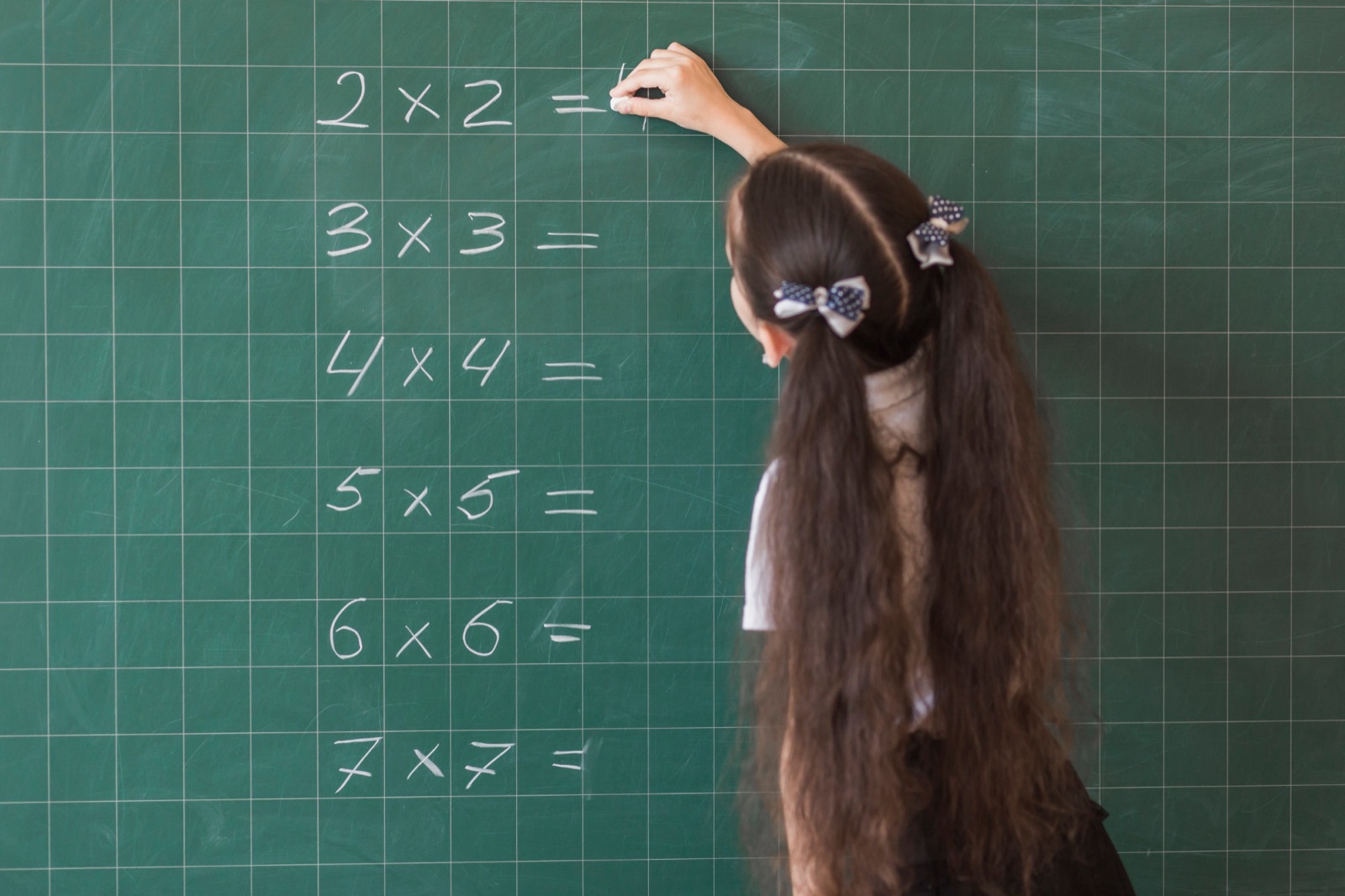
The times tables look like 100 facts. Learned in the right order, they're about ten. The twos are doubles your child already knows, the fives and tens are counting patterns, the squares and nines have hooks of their own, and every fact works both ways, so 7 × 8 and 8 × 7 are one fact, not two. What's left after that is a short list (3 × 4, 3 × 6, 3 × 7, 3 × 8, 4 × 6, 4 × 7, 4 × 8, 6 × 7, 6 × 8, 7 × 8), and each of those can be built from a fact the child already has. Five minutes a day, strategy said out loud, and short timed bursts only after the facts are reliable untimed: that's the routine, and the rest of this post is how to run it.
When are kids supposed to know their times tables?
The standards most states use ask third graders to multiply and divide within 100 using strategies, and "by the end of Grade 3, know from memory all products of two one-digit numbers." The same standards name the strategies: if you know 6 × 4, you know 4 × 6; and 8 × 7 can be found as 8 × 5 plus 8 × 2, which is 40 + 16. That second one is the whole method in a sentence. The standards don't say "chant until it sticks"; they say build the hard facts from the easy ones, then practice until recall is automatic.
In practice, plenty of fourth graders are still working on it, and a fourth grader who skip-counts to get 7 × 6 is behind the standard but not in trouble. A fifth grader who has no facts at all is in a harder spot, because long multiplication, division and fractions all assume the facts are free. That child doesn't need more worksheets; they need the order below and a few weeks.
What does my child actually have to memorize?
Start by shrinking the job, out loud, with your child watching. Write the 1-to-10 grid, then cross things off together.
Ones and tens need nothing. Twos are doubles, which children know from addition. Fives end in 0 or 5 and follow the clock. Nines have a pattern a nine-year-old loves: the tens digit is one less than the number you're multiplying, and the two digits add to nine (9 × 7: tens digit 6, 6 + 3 = 9, so 63). Squares (3 × 3, 4 × 4, 6 × 6, 7 × 7, 8 × 8) tend to stick on their own because they're memorable; learn them as a set. Then cross off every mirror image, because 3 × 8 and 8 × 3 are the same fact.
What's left is ten facts: 3 × 4, 3 × 6, 3 × 7, 3 × 8, 4 × 6, 4 × 7, 4 × 8, 6 × 7, 6 × 8, 7 × 8. Say that to a child who has been dreading "the times tables" and watch their shoulders drop.
Why don't flashcards alone work?
Because a flashcard asks for the answer before the child has a way to get it. A child who sees 7 × 8 and has nothing but memory to draw on guesses, and a wrong guess rehearsed is a wrong fact learned. Strategy first: 7 × 8 is 7 × 4 doubled (28, then 56), or 5 eights plus 2 eights (40 + 16). Once the child can build the fact in a few seconds, recall practice turns the building into remembering. Flashcards are the second step, not the first.
The other reason is how memory works. In a set of experiments on math practice, students who worked the same problems split across two sessions a week apart remembered far more a month later than students who did them all at once, and extra problems in a single sitting added nothing. The federal What Works Clearinghouse puts "space learning over time" first in its guide on organizing study. For times tables that means five minutes a day, not thirty on Sunday, and facts learned in March still showing up in May.
A five-minute daily routine
Five minutes, four or five days a week, out loud, no worksheet. Here's a six-week shape; stretch any week that needs it.
Week 1: twos, fives, tens. Mostly confirming what they know. Mix in a few "which is bigger, 5 × 6 or 2 × 9?" questions so the facts mean something.
Week 2: squares. Five facts. Say them as a chant if that helps ("three threes are nine"), then ask them out of order.
Week 3: nines. Teach the pattern, then ask nines out of order until the pattern isn't needed.
Weeks 4–5: the ten hard facts, two at a time. For each, pick the strategy the child likes and say it aloud every time until it's automatic. 6 × 7 is 6 × 5 plus 6 × 2 (30 + 12 = 42). 4 × 8 is double 2 × 8. 7 × 8 is 5 eights plus 2 eights.
Week 6 and after: mix everything. Pull a handful of facts from every group, including the easy ones, and keep doing five minutes a day. Add division as the same facts backwards: "40 ÷ 5" is "5 times what is 40?"
The daily five minutes: two minutes on this week's new facts with the strategy said aloud; two minutes on a mix of older facts (that's the spacing); one minute of the child quizzing you, which they will enjoy more than anything else in this post. Keep it untimed until a fact is right four or five days running.
Here's what the strategy step sounds like with a nine-year-old stuck on 8 × 7:
- Child"I don't know 8 times 7."
- Parent"Do you know 8 times 5?"
- Child"Forty."
- Parent"How many more eights do you need?"
- Child"Two. Sixteen."
- Parent"So?"
- Child"Fifty-six."
Tomorrow, ask 8 × 7 again and expect the same route. The day it comes out as "fifty-six" with no route, it's a fact.
If you'd like the strategy step to come from somewhere other than you, that's how Mathwell teaches multiplication: as pictures of rows and columns rather than a chant, so 7 × 8 is something a child can see split into 5 eights and 2 eights, and when a child is stuck, the Tutor offers the smaller step rather than the product. Mathwell is a browser-based K–5 math tutor that reads every problem aloud and teaches with hints instead of answers; anyone can try the demo lesson without signing up, and after that there's a 7-day free trial with a card on file, then $19 a month, $99 a year, or $169 for a three-year K–5 pass. It's for kindergarten through fifth grade only, and the child answers by tapping or typing, not by speaking. The kitchen-table version above works without it.
Should I use timed tests?
This is the most argued-about question in elementary math, and the honest answer is that the evidence is mixed and the practical answer is "briefly, late, and only against yourself."
The case for: the What Works Clearinghouse's 2021 guide for elementary students who struggle with math recommends regularly including timed activities as one way to build fluency, and rates the evidence strong. In a Vanderbilt study of struggling first graders, children who spent a few minutes answering as many fact cards as they could in 60 seconds, trying to beat their own score, ended 16 weeks with much higher math achievement than children who played untimed games instead.
The case against: Stanford's Jo Boaler has argued for years that timed tests cause math anxiety and should be dropped, and many teachers and parents have seen a child freeze at a "mad minute." When the Hechinger Report examined the dispute in 2023, it found no well-designed experiment showing that timed tests cause anxiety, and concluded the question remains open.
So: don't start with the clock. Build the strategies, get the facts reliable untimed, and then add one-minute bursts where the child tries to beat their own score from yesterday, never a classmate's and never a pass mark. If a child melts down at the timer, drop it for a month and keep the untimed practice; the facts will still come, more slowly. What to say when your child cries over math homework applies to the mad-minute meltdown too.
My child knows them on Monday and forgets by Friday. What's wrong?
Nothing. That's what memory looks like before spacing. A fact practiced on Monday only will be gone by Friday; a fact practiced Monday, Wednesday and Friday, then once the next week, then once a month, stays. The mix-in step of the routine exists for exactly this. If forgetting continues after a few weeks of daily mixed practice, check that the strategies are really there: ask the child how they'd get 6 × 8 if they forgot it. A child with a route recovers the fact; a child with no route is back to guessing, and that's where to go back to.
For how this fits in the rest of the day, how much math practice a day, by grade has the schedule; the same strategy-first approach for addition facts is in the age-by-age answer on finger counting.
FAQ
What order should kids learn times tables in?
Twos, fives and tens; then squares; then nines; then the ten facts left over, two at a time; then everything mixed. Not 1 through 12 in order, which front-loads the easy ones and leaves the hard ones for last, together.
Is skip-counting okay?
As a bridge in third grade, yes. By fourth, a child skip-counting "7, 14, 21, 28" for every fact needs the strategies above and a few weeks of recall practice, because skip-counting is too slow to carry long multiplication.
Do songs and chants work?
For the sequence, yes, and they're fun. The catch is that a chant retrieves facts in order, and your child needs 7 × 8 on its own. Use the song, then ask the facts out of order.
Does my child need to learn division facts separately?
No. They're the same facts read backwards: 56 ÷ 7 is "7 times what is 56?" Once multiplication is reliable, ask each fact both ways.
My 10-year-old still doesn't know them. Is it too late?
Not at all. A fifth grader with the routine above and real daily practice usually gets there in six to eight weeks. Tell the teacher you're working on it; they can keep class work from depending on facts the child doesn't have yet.
Sources
- Common Core State Standards for Mathematics, Grade 3, Operations & Algebraic Thinking: 3.OA.B.5 and 3.OA.C.7. Text mirrored at thecorestandards.org.
- Institute of Education Sciences, What Works Clearinghouse (2021), Assisting Students Struggling with Mathematics: Intervention in the Elementary Grades, Recommendation 6 (timed activities). Summary (PDF)
- Institute of Education Sciences, What Works Clearinghouse (2007), Organizing Instruction and Study to Improve Student Learning, Recommendation 1 (spacing). Guide
- Rohrer & Taylor (2006), The effects of overlearning and distributed practice on the retention of mathematics knowledge, Applied Cognitive Psychology. Abstract
- Barshay, J. (2023), Proof Points: Do math drills help children learn?, The Hechinger Report: the Vanderbilt (Fuchs, 2013) speed-practice study and the timed-tests debate. Article